A Standard of Excellence that sets Miura apart from other Process Steam Boiler manufacturers
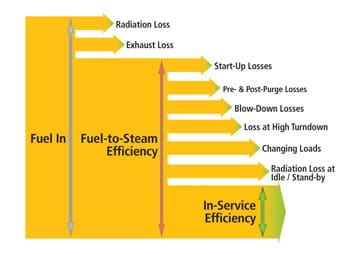
In-Service Efficiency represents a true measure of real-world performance across all operating conditions, regardless of how demand fluctuates. Miura customers can expect consistently high levels of this performance because the metric accounts for every aspect of boiler operation (see chart below). To better understand this concept, it helps to review the traditional efficiency terms commonly used in the industry. Miura introduced the term “In-Service Efficiency” to encompass:
- Combustion Efficiency
- Thermal Efficiency
- Fuel-to-Steam Efficiency
Miura defines In-Service Efficiency as the actual efficiency achieved when a boiler’s complete operating cycle is considered — including daytime and nighttime use, weekdays and weekends, peak demand periods, reduced loads, and standby conditions.
This holistic measurement reflects the true “bottom-line” efficiency of a boiler system and provides a more meaningful basis for comparing designs. It demonstrates how effectively a boiler performs under real operating scenarios rather than ideal laboratory conditions.
Highest In-Service Efficiencies in the industrial boiler industry
With current fuel prices, Miura customers typically realize about 20% lower steam production costs compared with conventional boiler systems. Depending on the application, fuel savings often range from 10% to 40%. For example, a standard 600 BHP steam installation operating on natural gas priced at $0.90 per therm could see annual fuel savings of roughly $200,000.
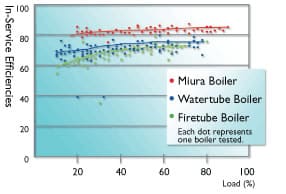
The chart below compares Miura’s in-service performance with both firetube and watertube boilers. Miura’s design maximizes heat transfer efficiency while maintaining low water volume, achieving fuel-to-steam efficiencies around 85%. While many firetube boilers can reach up to 83% under ideal conditions, real-world studies indicate Miura systems typically consume 10% to 40% less fuel than standard firetube designs due to their operational advantages.